Web Tools · HoekBrown

HoekBrown — Rock Mass Strength From GSI To Mohr–Coulomb, With The Charts Built In.

Converts intact rock and rock mass inputs (mi, σci, GSI, D) into equivalent Mohr–Coulomb c′ and φ′ plus rock mass tensile strength, uniaxial compressive strength and deformation modulus, per the Generalised Hoek–Brown criterion of Hoek, Carranza-Torres & Corkum (2002). The mi table, the GSI chart and the disturbance-factor guidance are on screen and clickable. Free with a KeoGeo sign-in.

v1.2 · runs in your browser · free with an account
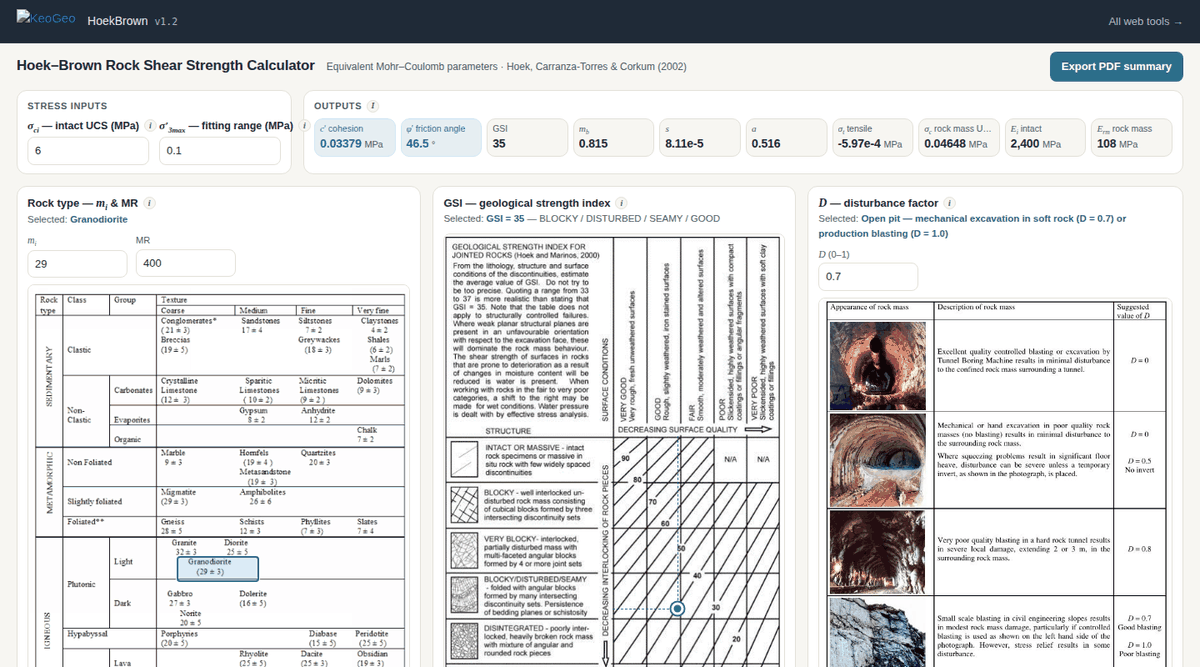
HoekBrown web app — Stress inputs and outputs in the bar across the top; the rock-type table, the interactive GSI chart and the disturbance-factor guidance side by side below, with the strength envelopes beneath.

Stress inputs and outputs in the bar across the top; the rock-type table, the interactive GSI chart and the disturbance-factor guidance side by side below, with the strength envelopes beneath.

What It Does

The 2002 Criterion, Without Flipping Between The Paper And A Spreadsheet.

Most engineers estimate rock mass strength by looking up three charts and typing the numbers into a spreadsheet. HoekBrown puts the charts on the page and does the fit:

  • Rock mass constants — mb = mi·e(GSI−100)/(28−14D), s = e(GSI−100)/(9−3D), a = ½ + (e−GSI/15 − e−20/3)/6.
  • Equivalent Mohr–Coulomb — c′ and φ′ fitted over σ′3 = 0 … σ′3max with a user-defined fitting stress range.
  • Rock mass properties — tensile strength σt, uniaxial compressive strength σc and deformation modulus Erm (Hoek–Diederichs form with Ei = MR·σci).
  • Click-to-select rock type — click a rock in the mi reference table to set mi and the modulus ratio MR, with manual overrides for both.
  • Interactive GSI chart — click or drag the marker on the Hoek & Marinos (2000) structure-versus-surface-condition chart; N/A zones are flagged.
  • Disturbance factor — click an excavation case row on the D guidance chart, then adjust D manually if required.
  • Live envelopes — principal-stress and Mohr-envelope charts comparing Hoek–Brown with the fitted Mohr–Coulomb line, and a print-ready PDF report.

Need to run many cases? KeoGeo Pro adds a CSV batch processor to this tool — A$20/month, cancel any time.

Example Outputs

What You Get Out Of It.

Equivalent c′ And φ′

Fitted Mohr–Coulomb parameters for your σ′3 range, shown in the output bar and on the shear-strength envelope.

Rock Mass Properties

σt, σc, Erm and the constants mb, s and a, in maths notation with sub- and superscripts.

Strength Envelopes

Principal-stress and τ–σn plots of Hoek–Brown versus the Mohr–Coulomb fit, updated as you change any input.

PDF Report

A print-ready summary of inputs, chart selections, results and the version stamp.

Method & References

What The Numbers Are Based On.

Every calculation in HoekBrown is tied to a published source, and the in-app Sources & References section repeats this list next to the calculations themselves:

  • Hoek, E., Carranza-Torres, C. & Corkum, B. (2002). Hoek–Brown failure criterion — 2002 edition. Proc. NARMS-TAC, Toronto.
  • Hoek, E. & Marinos, P. (2000). Predicting tunnel squeezing problems in weak heterogeneous rock masses — GSI chart for structure and surface condition.
  • Hoek, E. & Diederichs, M.S. (2006). Empirical estimation of rock mass modulus. Int. J. Rock Mech. Min. Sci. 43 — Erm from GSI, D and Ei.
  • Hoek, E. & Brown, E.T. (1997). Practical estimates of rock mass strength — mi values by rock type; modulus ratio MR after Deere (1968).
Limitations

Where It Stops, And What You Still Have To Check.

  • Results are unvalidated: check them against laboratory data and project-specific requirements before use in design — engineering judgement is required.
  • GSI is estimated from a chart position; it is not a substitute for field mapping and classification.
  • The Mohr–Coulomb fit depends strongly on the chosen σ′3max — use the range appropriate to the application (slope, tunnel or foundation) per Hoek et al. (2002).

All KeoGeo tools are provided for preliminary assessment and educational purposes. Results must be verified by a suitably qualified engineer before use in design or construction; the full disclaimer is inside the app and in our terms.