Web Tools · KeoBear

KeoBear — Bearing Capacity, Sliding And Settlement For Shallow Foundations.

Ultimate bearing capacity (Vesic, Meyerhof or Hansen), sliding resistance and settlement of strip, rectangular, square, circular and annular footings on multilayer cohesive and granular profiles — with every number traceable in a permanently visible calculation trail. Runs in your browser, free with a KeoGeo sign-in.

v2.0.0 · runs in your browser · free with an account
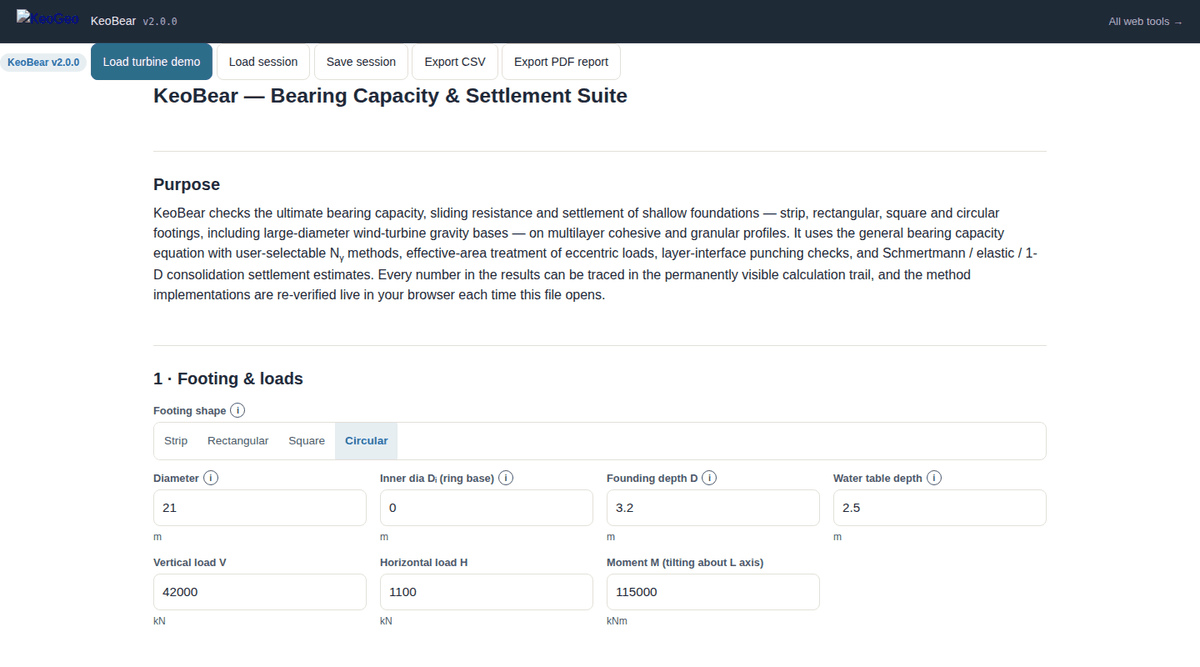
KeoBear web app — Footing, loads and soil profile at the top; factor-of-safety cards, plan of the effective bearing area and the calculation trail beneath.

Footing, loads and soil profile at the top; factor-of-safety cards, plan of the effective bearing area and the calculation trail beneath.

What It Does

The General Bearing Equation, With The Checks Engineers Actually Run.

KeoBear applies the general bearing capacity equation with user-selectable Nγ methods and De Beer / Hansen / Vesic correction factors, then carries the same footing through sliding, punching, settlement and time-rate checks:

  • Footing shapes — strip (per metre run), rectangular, square and circular, including large wind-turbine gravity bases with DNV-ST-0126 effective-area treatment of eccentric loads (e/R gap and excessive-eccentricity flags) and annular (ring) bases via an equal-area circle with an exact ring-kern gapping check.
  • Layered profiles — cohesive and granular layers with failure-zone-weighted parameters, drained and undrained (φ = 0) checks, 2:1 layer-interface punching checks, Meyerhof–Hanna (1978) sand-over-clay punch-through, and Das groundwater cases I–III.
  • Two safety formats — working-stress factor of safety, or limit-state design to AS 5100.3 with the geotechnical strength reduction factor φg, side by side.
  • Sliding and inclination — base friction δ = φ′, ⅔φ′ or custom plus α·su adhesion; Vesic load-inclination factors; Hansen (1970) ground-slope and base-tilt factors; pseudo-static seismic screening (kh·V, AS 1170.4 context).
  • Settlement — Schmertmann (1978) strain-influence for granular soils, elastic immediate settlement for cohesive soils, Terzaghi 1-D consolidation with OCR, and t50/t90 time-rate curves with single or double drainage.
  • Differential settlement — angular-distortion check against the 1/500 limit (Bjerrum); rotational stiffness Kφ = 8GR³/3(1−ν) and tilt checks for turbine bases.
  • Load cases and sensitivity — a multi-load-case runner and a one-at-a-time tornado (φ′ ± 2°, su ± 20 %, GWT ± 1 m, V ± 10 %) so you can see which input actually governs.
  • KeoCPT import — one-click import of a .keocpt-layers.json stratigraphy exported from KeoCPT; session autosave in the browser.

Need to run many cases? KeoGeo Pro adds a CSV batch processor to this tool — A$20/month, cancel any time.

Example Outputs

What You Get Out Of It.

Factor Of Safety By Mode

Bearing, sliding and punching factors of safety (or LSD utilisations) per load case, colour-coded, with the governing mode called out.

Plan And Profile Diagrams

Effective bearing area in plan, the soil profile with influence depths, and the stress-increase / strain-influence diagram used for settlement.

Calculation Trail

Every equation with the numbers substituted, in maths notation, permanently visible — nothing hidden behind a toggle.

PDF Report And CSV

A print-ready report with inputs, factors, verification status and an embedded session code; results also export to CSV.

Method & References

What The Numbers Are Based On.

Every calculation in KeoBear is tied to a published source, and the in-app Sources & References section repeats this list next to the calculations themselves:

  • Prandtl (1921) and Reissner (1924) — closed-form Nc, Nq.
  • Meyerhof (1953, 1963) — effective-width method for eccentric loads; shape, depth and inclination factors; Nγ.
  • Vesic (1973, 1975) — Nγ, inclination factors and the general bearing capacity equation.
  • Hansen (1970) — revised bearing capacity factors, depth factors, ground-slope and base-tilt factors.
  • De Beer (1970) — experimental shape factors. Das, Principles of Foundation Engineering — factor tables and groundwater cases I–III.
  • NAVFAC DM-7.01 — 2:1 stress distribution for layer-interface checks; Meyerhof & Hanna (1978) — punch-through of a strong layer over a weak one.
  • Schmertmann et al. (1978) — strain-influence settlement of granular soils; Boussinesq / Newmark (1935) and Harr (1966) — elastic stress increase and influence factors.
  • Terzaghi — 1-D consolidation theory (Cc/Cr method and time factors). Bjerrum — angular-distortion damage limits.
  • DNV-ST-0126 — wind turbine gravity foundations: effective area of circular bases, e/R limits and rotational stiffness. AS 5100.3 — geotechnical strength reduction factors; AS 1170.4 — pseudo-static context.
Limitations

Where It Stops, And What You Still Have To Check.

  • Shallow foundations only (D/B ≲ 2.5); no piles.
  • Layered capacity uses failure-zone-weighted parameters plus 2:1 and Meyerhof–Hanna punching checks — a standard design approach, but not a rigorous multi-layer plasticity or finite-element limit analysis.
  • Eccentric circular bases use the DNV effective-area idealisation; results are flagged as unreliable for e/R > 0.4. Verify final ring-base designs against the turbine supplier's method.
  • Settlement estimates are elastic, empirical or 1-D approximations; no secondary compression beyond the Schmertmann creep term. Time-rate uses a single equivalent cv and drainage path.
  • The pseudo-static kh case is a screening check, not a site-specific seismic design.

All KeoGeo tools are provided for preliminary assessment and educational purposes. Results must be verified by a suitably qualified engineer before use in design or construction; the full disclaimer is inside the app and in our terms.