Web Tools · KeoConsol

KeoConsol — Consolidation Settlement, Creep And Rate With Wick Drains.

Primary consolidation settlement, creep and the rate of consolidation of an embankment or preload over layered fine-grained ground, with optional prefabricated vertical drains — the fill load solved together with settlement-induced submergence, layers by the Mv or OCR (Cc/Cr) method, and Hansbo (1981) radial drainage with smear and well resistance. Free with a KeoGeo sign-in.

v1.0 · runs in your browser · free with an account
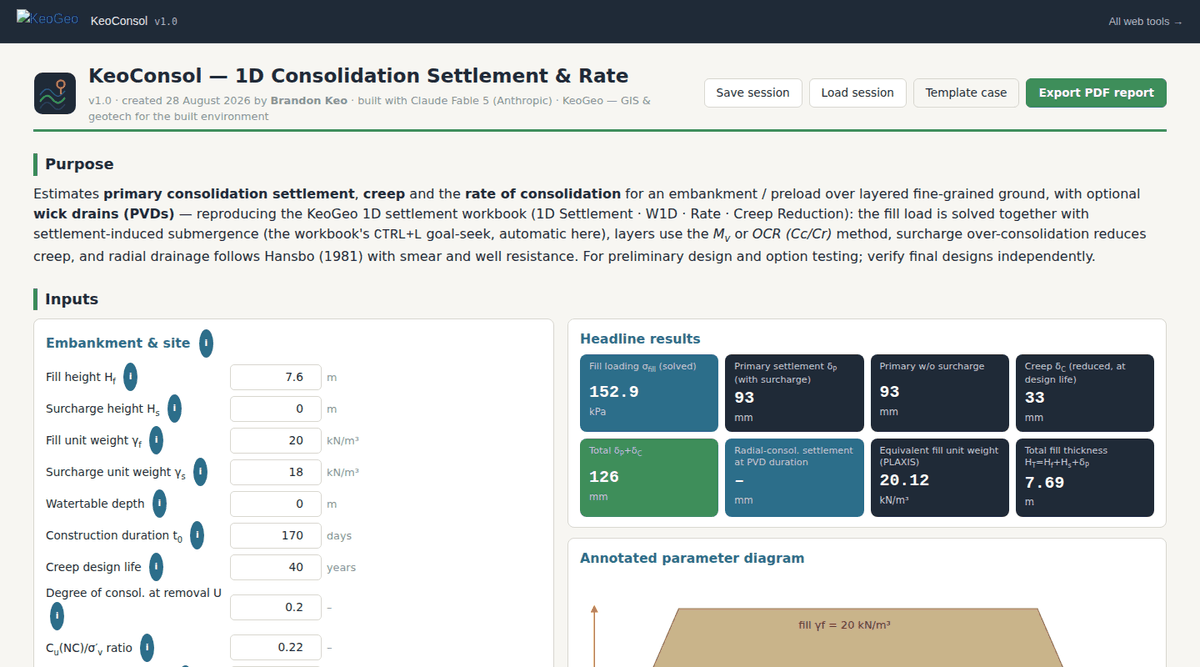
KeoConsol web app — Embankment, site and PVD inputs with headline results and the annotated parameter diagram at the top; the layered ground model, time–settlement curve and full calculation trail below.

Embankment, site and PVD inputs with headline results and the annotated parameter diagram at the top; the layered ground model, time–settlement curve and full calculation trail below.

What It Does

The Settlement Workbook Every Soft-Ground Project Has — Rebuilt To Be Checkable.

KeoConsol replicates a project 1D settlement workbook (1D Settlement · W1D · Rate · Creep Reduction · Consol degree · Parameters sheets) so that the maths is transparent and the goal-seek is automatic:

  • Layered profile, two methods — per-layer primary settlement by the Mv method (mv from E′ and ν) or the OCR method (C/C log-stress with SHANSEP OCR back-figured from cu), with a σ′v0 profile split at the water table.
  • Fill load ⇄ settlement goal-seek — the workbook's CTRL+L macro replaced by an automatic fixed-point solve of σfill and δP (tolerance 10⁻¹⁰ mm), including the settled-fill submergence term across six watertable scenarios.
  • Creep — Cαε log-time law with the surcharge over-consolidation reduction table.
  • Wick drains — Hansbo (1981) radial consolidation: equivalent drain diameter, triangular or square spacing, smear zone (Indraratna & Redana) and per-layer well resistance; free-draining layers and layers below the drain toe handled as in the source sheet.
  • Rate of consolidation — Sivaram & Swamee (1977) closed-form Uv(Tv) for untreated layers; Ur = 1 − exp(−8Tr/α) for drained layers; time–settlement curve with a construction ramp.
  • 107-class soil library — pick a GIR class to auto-fill γ, ν, cu, E′, cv, C, C and Cαε; every cell stays editable and edited cells are highlighted and listed in the report.
  • Live section — an annotated cross-section drawn to scale from the current inputs (fill, surcharge, water table, layers, PVDs, settled base).
  • Batch-ready — exposes a KEOGEO_BATCH manifest for the KeoGeo Webapp Batch Processor.

Need to run many cases? KeoGeo Pro adds a CSV batch processor to this tool — A$20/month, cancel any time.

Example Outputs

What You Get Out Of It.

Headline Results

Fill pressure, primary settlement per layer and total, creep, time to 90 % consolidation and the drained/undrained profile totals.

Time–Settlement Curve

Construction ramp plus per-layer vertical or radial degree of consolidation and creep, with the per-layer settlement profile chart beside it.

Calculation Trail

Every layer's mv, σ′v0, δP, final OCR and creep factor written out with numbers substituted and the workbook cell it reproduces.

PDF Report

Version, date, user, edited coefficients and an embedded session-restore JSON, plus save/load session buttons.

Method & References

What The Numbers Are Based On.

Every calculation in KeoConsol is tied to a published source, and the in-app Sources & References section repeats this list next to the calculations themselves:

  • Terzaghi (1943). Theoretical Soil Mechanics — 1D consolidation theory (δ = mv·Δσ·H and the Cc/Cr log-stress form).
  • Sivaram & Swamee (1977). A computational method for consolidation coefficient. Soils and Foundations 17(2) — closed-form Uv(Tv).
  • Hansbo (1981). Consolidation of fine-grained soils by prefabricated drains. Proc. 10th ICSMFE, Stockholm — radial consolidation with smear and well resistance.
  • Indraratna & Redana (1998) — smear zone extent; Ladd & Foott (1974) — SHANSEP normalised strength (S = 0.22, m = 1 defaults).
  • Source workbook: 1D Settlement Calculation, Logan & Gold Coast Faster Rail project (job Q80620) — every formula is tied to its source cell in the Calculations and Verification sections.
Limitations

Where It Stops, And What You Still Have To Check.

  • One-dimensional vertical strain only — no lateral deformation and no stress spreading with depth (Δσ constant over the profile, as in the source workbook). Conservative under narrow embankments; do not use for footings.
  • Constant-fill-height mode only: the fill is assumed topped up to design level as it settles. The workbook's variable-height branch is not implemented.
  • Creep is not coupled to the degree of primary consolidation (Hypothesis A); radial and vertical drainage are not superposed.
  • Strength-gain, Asaoka and PLAXIS-matching tabs of the source workbook are out of scope — the time–settlement curve is an analytical approximation for preliminary design.

All KeoGeo tools are provided for preliminary assessment and educational purposes. Results must be verified by a suitably qualified engineer before use in design or construction; the full disclaimer is inside the app and in our terms.