Web Tools · KeoCPT

KeoCPT — CPT Interpretation And Liquefaction Screening In Your Browser.

Import a CPTu sounding (CSV, TXT or pasted from a spreadsheet) and get Robertson (2009) normalised parameters and soil behaviour types, published design-parameter correlations, Boulanger & Idriss (2014) or NCEER liquefaction triggering with LPI, LSN and free-field settlement — plus automatic AS 1726:2017 stratigraphy across a multi-CPT site. Nothing is uploaded; it runs entirely in your browser.

v2.1.0 · runs in your browser · free with an account
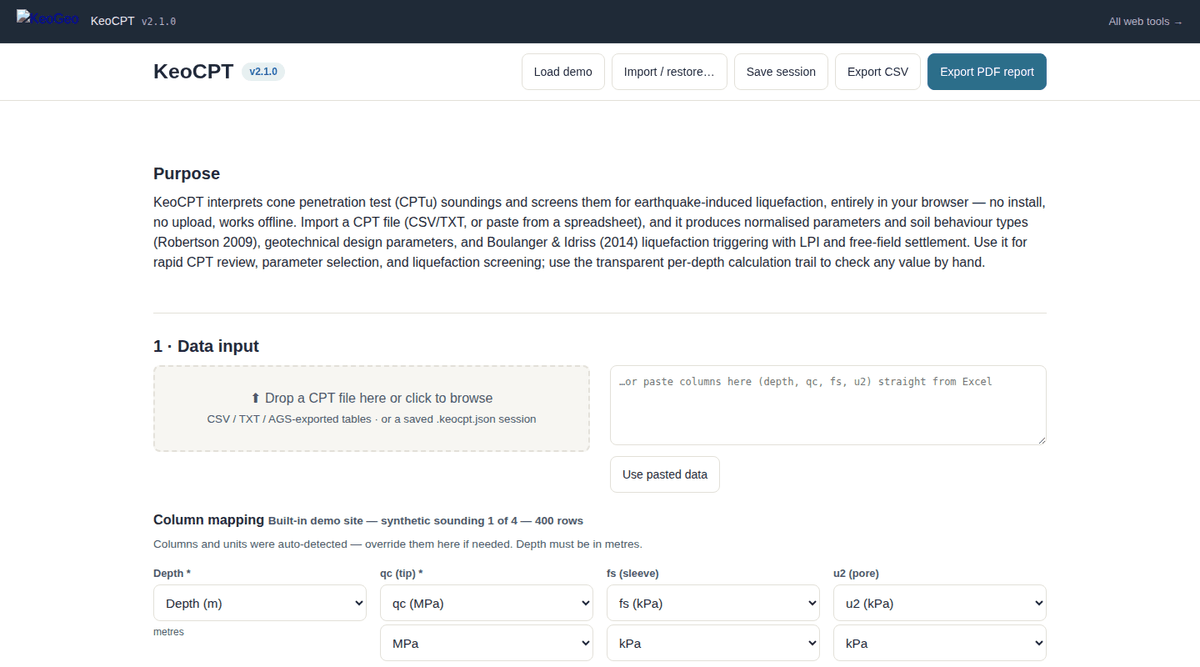
KeoCPT web app — Data import and column mapping at the top; interpretation profiles, the SBTn chart, the liquefaction screen and the per-depth calculation trail follow down the page.

Data import and column mapping at the top; interpretation profiles, the SBTn chart, the liquefaction screen and the per-depth calculation trail follow down the page.

What It Does

From Raw Cone Data To Design Parameters, Stratigraphy And A Liquefaction Screen.

KeoCPT works the way a CPT review actually goes — clean the data, normalise it, classify it, pull parameters, then screen for liquefaction — and keeps every step visible:

  • Robust import — CSV/TXT or paste, automatic column and unit detection with manual override, thin-layer and transition-zone detection.
  • Robertson (2009) normalisation — Qtn, Fr and Ic with the iterated stress exponent n, and the 9-zone SBTn classification chart with behaviour-type names in the backdrop.
  • Design parameters — su (Nkt), OCR, φ′, Dr, Vs, G0, constrained modulus, permeability and N60, each tied to a published reference.
  • Liquefaction triggering — Boulanger & Idriss (2014) or NCEER (Youd et al. 2001): qc1Ncs, CSR/CRR, FoS, MSF and Kσ; then LPI (Iwasaki 1978), LSN (van Ballegooy 2014), lateral displacement index (Zhang et al. 2004) and free-field settlement (Zhang et al. 2002).
  • Automatic stratigraphy — layers with AS 1726:2017 soil descriptions, depth-band design averages, and a clickable layer detail panel that also moves the calculation trail to that layer.
  • Multi-CPT site — soundings with easting, northing and RL; an interactive plan view and a rotatable 3D fence viewer of the site stratigraphy (a four-sounding demo site loads for review).
  • Nkt correlator — pair shear-vane or borehole su data with CPT depths, apply the Bjerrum (1972) vane correction, and fit a least-squares Nkt with r² and COV, exportable as validation evidence.
  • Hand-off to KeoBear — one-click .keocpt-layers.json export straight into the bearing capacity suite; Excel site export with locations, per-sounding stratigraphy and depth bands.
Example Outputs

What You Get Out Of It.

Interpretation Profiles

qt, fs, u2, Ic, SBTn zone and every derived parameter plotted against depth — click any chart to move the calculation trail to that depth.

Liquefaction Screen

Factor of safety, LPI, LSN and settlement profiles for your design earthquake, with the method's validity range flagged.

Site Stratigraphy

AS 1726 layer table, plan view and 3D fence diagram across all soundings, exportable to Excel.

Calculation Trail And Report

Per-depth maths in proper notation with equation citations; PDF report that embeds a session file for full restore, plus CSV export.

Method & References

What The Numbers Are Based On.

Every calculation in KeoCPT is tied to a published source, and the in-app Sources & References section repeats this list next to the calculations themselves:

  • Robertson, P.K. (2009). Interpretation of cone penetration tests — a unified approach. Can. Geotech. J. 46(11) — normalisation, SBTn, moduli.
  • Robertson & Cabal (2015). Guide to Cone Penetration Testing, 6th ed. — su/Nkt, N60, permeability; Robertson & Cabal (2010) — unit weight from CPT.
  • Boulanger & Idriss (2014). CPT and SPT based liquefaction triggering procedures. UCD/CGM-14/01 — CN, qc1Ncs, fines from Ic, CRR, MSF, Kσ, rd. Idriss & Boulanger (2008), EERI MNO-12.
  • Youd et al. (2001) — NCEER/NSF workshop procedure; Robertson & Wride (1998).
  • Iwasaki et al. (1978) — liquefaction potential index; van Ballegooy et al. (2014) — liquefaction severity number; Zhang, Robertson & Brachman (2002, 2004) — settlement and lateral displacement.
  • AS 1726:2017 — geotechnical site investigations, soil description conventions. Bjerrum (1972) — field vane correction.
Limitations

Where It Stops, And What You Still Have To Check.

  • Screening-level interpretation for standard 10 cm² / 15 cm² electric cones; not applicable to gravels, cemented, aged or highly sensitive soils without judgement.
  • All parameter correlations are empirical with significant scatter — calibrate Nkt, γ and fines content to laboratory data where available.
  • Liquefaction screening covers sand-like soils below the water table under level-ground, free-field conditions. Cyclic softening of clays, lateral spreading and sloping-ground effects are out of scope; B&I (2014) is calibrated for roughly M 5.5–8.5 and σ′v ≲ 6–8 atm and the app warns outside that range.
  • Settlement is free-field volumetric reconsolidation only — no shear-induced, building-induced or lateral-spreading components.

All KeoGeo tools are provided for preliminary assessment and educational purposes. Results must be verified by a suitably qualified engineer before use in design or construction; the full disclaimer is inside the app and in our terms.