Web Tools · KeoWall

KeoWall — Staged Embedded Retaining Wall Analysis, Live As You Type.

A WALLAP-style analysis of diaphragm, secant/contiguous pile, sheet pile or custom embedded walls: a staged subgrade-reaction (beam–spring) model with elasto-plastic soil springs, a limit-equilibrium factor of safety per stage, and a true-to-scale cross-section beside elevation-aligned displacement, bending moment, shear and earth-pressure diagrams. Everything recomputes in about 60 ms. Free with a KeoGeo sign-in.

v1.0 · runs in your browser · free with an account
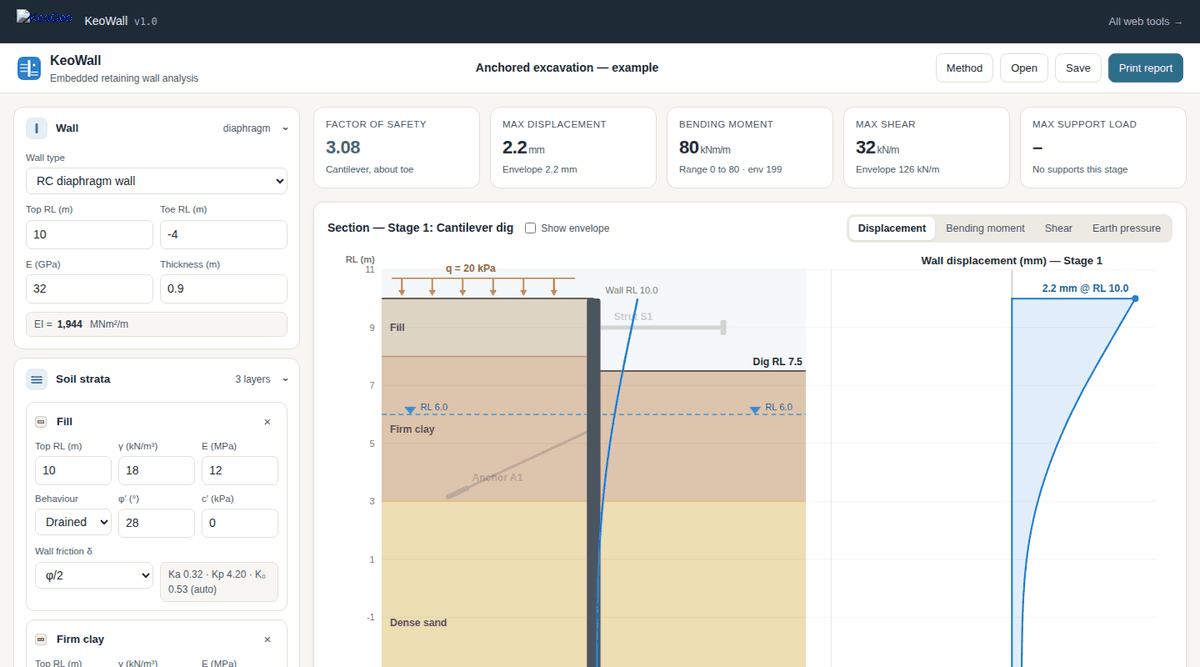
KeoWall web app — Wall, strata and stage inputs on the left; factor-of-safety and maximum-effect cards across the top; the annotated section and diagrams update as you type.

Wall, strata and stage inputs on the left; factor-of-safety and maximum-effect cards across the top; the annotated section and diagrams update as you type.

What It Does

Two Analyses In One Pass: Deformation From Springs, Safety From Limit Equilibrium.

KeoWall models the wall the way the established retaining-wall programs do, but with an interface built around live recompute and reading the results, not filling in dialogue boxes:

  • Staged beam–spring model — elasto-plastic soil springs at every node (elastic, active limit, passive limit), solved per construction stage so displacements, moments and pressures carry forward.
  • Limit-equilibrium factor of safety — strength factoring: tan φ′ and c′ (or cu) divided by F, iterated until moment equilibrium. Cantilever stages take moments about the toe; propped stages about the highest active support (free-earth method). Water pressures enter unfactored.
  • Earth pressures — Coulomb Ka/Kp with wall friction, drained and undrained strata, water pressures with optional toe balancing, uniform surcharges.
  • Supports — prestressed struts and inclined anchors, installed at the stage you choose.
  • Construction sequence — excavation, water-level changes, support installation and surcharge application, stage by stage, with stage chips to step through.
  • Live section and diagrams — strata, water, dig level, supports with computed loads and an exaggerated deflected shape, beside displacement, bending-moment, shear and earth-pressure diagrams with an all-stage envelope toggle.
  • Checks and reporting — automatic embedment, FoS-target and convergence checks; stage summary table; JSON save/open; print report; a method-and-assumptions panel in the app.

Need to run many cases? KeoGeo Pro adds a CSV batch processor to this tool — A$20/month, cancel any time.

Example Outputs

What You Get Out Of It.

Per-Stage FoS Cards

Limit-equilibrium factor of safety, maximum displacement, bending moment, shear and support load for the selected stage, colour-coded against your targets.

Annotated Cross-Section

True-to-scale section with strata, water levels, dig level, supports and the deflected wall shape.

Envelope Diagrams

Displacement, moment, shear and pressure plotted at elevation, per stage or as an all-stage envelope.

Stage Summary And Report

A table of every stage's key effects, the checks list, and a print report or JSON session file.

Method & References

What The Numbers Are Based On.

Every calculation in KeoWall is tied to a published source, and the in-app Sources & References section repeats this list next to the calculations themselves:

  • Subgrade-reaction (Winkler) beam–spring method for embedded walls, with ks derived from soil stiffness E — the approach behind Geosolve WALLAP's deformation analysis.
  • Limit-equilibrium strength-factor method for the factor of safety, in the spirit of WALLAP's stability analysis; free-earth support for propped walls.
  • Coulomb (1776) active and passive earth pressure coefficients with wall friction; total-stress Ka/Kp with c = su for undrained strata.
  • Hydrostatic water pressures with optional balancing of net water pressure at the toe.
Limitations

Where It Stops, And What You Still Have To Check.

  • Winkler springs (ks from E) capture no soil–structure continuum effects — verify with validated software (WALLAP, PLAXIS) before design use.
  • Undrained behaviour uses total-stress Ka/Kp with c = su; no consolidation or time effects.
  • No berms, sloping ground or strip surcharges; hydrostatic water only (no seepage); no EC7 / AS 4678 partial-factor sets yet — the FoS is a strength factor.
  • The engine targets typical excavation geometries; extreme geometries may need mesh or iteration tuning.

All KeoGeo tools are provided for preliminary assessment and educational purposes. Results must be verified by a suitably qualified engineer before use in design or construction; the full disclaimer is inside the app and in our terms.