Web Tools · LPileWeb

LPileWeb — Nonlinear p-y Lateral Pile Analysis, LPILE-Style, In Your Browser.

A finite-difference beam-column solver on nonlinear p-y springs, following the COM624P/LPILE formulation: soft clay (Matlock), stiff clay with and without free water (Reese, Welch), Reese and API sand, elastic subgrade and user-defined curves; static or cyclic loading; free, fixed, rotationally restrained, prescribed-displacement and applied-moment heads; axial P-Δ and multi-section piles. Free with a KeoGeo sign-in.

v1.0 · runs in your browser · free with an account
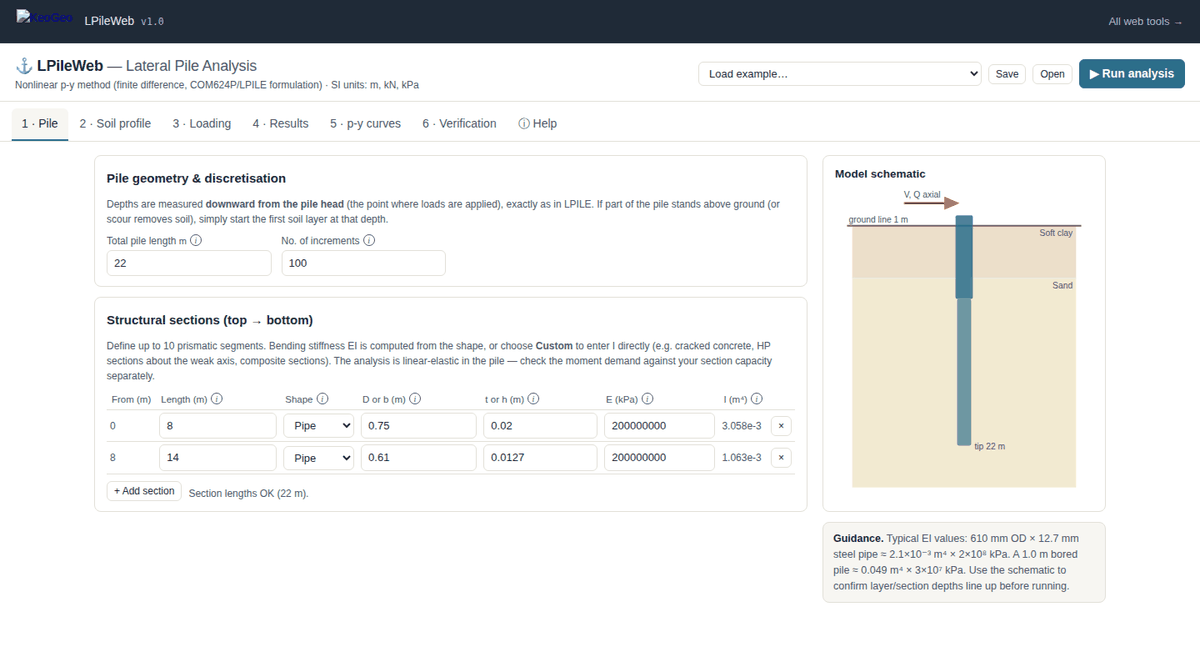
LPileWeb web app — Pile geometry and structural sections first, then the layered soil profile with a live schematic; loading, results, p-y curves and the verification suite follow as tabs.

Pile geometry and structural sections first, then the layered soil profile with a live schematic; loading, results, p-y curves and the verification suite follow as tabs.

What It Does

The p-y Method, With The Manual's Worked Examples Built In.

LPileWeb recreates the desktop LPILE workflow from its published user's manual so a lateral pile check can be run, inspected and printed without leaving the browser:

  • Soil model library — soft clay (Matlock 1970), stiff clay with free water (Reese et al. 1975) and without (Welch & Reese 1972), sand (Reese, Cox & Koop 1974), sand (API / O'Neill), elastic subgrade, and user-defined p-y curves; p- and y-multipliers per layer.
  • Loading — static or cyclic; shear, moment, axial load and distributed lateral load; multiple load cases run side by side.
  • All five head conditions — free head, fixed head, rotational restraint, prescribed displacement and applied moment — with axial P-Δ included in the beam-column.
  • Multi-section piles — up to ten prismatic segments (pipe, circular, rectangular or custom I), EI computed from the shape or entered directly for cracked or composite sections.
  • Live schematic and guidance — the model is drawn as you type so layer and section depths line up; every input carries commentary on what it expects and the published default it falls back to (ε50, k).
  • Results — deflection, slope, moment, shear, soil reaction and modulus profiles with depth, load–deflection curves, and a p-y curve inspector at any depth.
  • Verification suite — nine closed-form beam-on-elastic-foundation checks (Hetényi) and the LPILE manual's Example 3, re-run in-browser; a comparison panel accepts pasted desktop LPILE results.
  • Export — CSV results, print reports, save/open model files.

Need to run many cases? KeoGeo Pro adds a CSV batch processor to this tool — A$20/month, cancel any time.

Example Outputs

What You Get Out Of It.

Depth Profiles

Deflection, slope, bending moment, shear, soil reaction and modulus versus depth for every load case.

Load–Deflection Curves

Head deflection and maximum moment against applied load, for the pile as configured.

p-y Curve Inspector

The mobilised p-y curve at any depth, with the model, parameters and cyclic reduction shown.

Results Table And CSV

Per-node results at every increment, exportable to CSV, plus a print-ready report.

Method & References

What The Numbers Are Based On.

Every calculation in LPileWeb is tied to a published source, and the in-app Sources & References section repeats this list next to the calculations themselves:

  • Reese, L.C. & Van Impe, W.F. — Single Piles and Pile Groups Under Lateral Loading; COM624P / LPILE finite-difference formulation (Ensoft LPILE v2026 User's Manual).
  • Matlock (1970) — soft clay p-y curves; Reese, Cox & Koop (1975) — stiff clay with free water; Welch & Reese (1972) — stiff clay without free water.
  • Reese, Cox & Koop (1974) — sand; API RP 2GEO / O'Neill & Murchison (1983) — API sand.
  • Hetényi (1946) — beams on elastic foundation, used for the closed-form verification cases.
Limitations

Where It Stops, And What You Still Have To Check.

  • Recreated from the published manual, not the program source — behaviour at edge cases (for example cyclic stiff clay with free water) should be spot-checked against desktop LPILE using the comparison panel.
  • The pile is linear-elastic; check moment demand against your section capacity separately (no nonlinear cracked-EI section analysis yet).
  • Weak rock and liquefied-sand p-y models are not yet included; no pile-group effects beyond manual p-multipliers.
  • Very fine finite-difference meshes on long piles may be slow in the browser.

All KeoGeo tools are provided for preliminary assessment and educational purposes. Results must be verified by a suitably qualified engineer before use in design or construction; the full disclaimer is inside the app and in our terms.