Web Tools · WorkPlat

WorkPlat — Working Platform Thickness To BR 470 And TWf2024:03, Side By Side.

Enter the subgrade, groundwater, platform material, plant loading and geometry once and both design methods run live: the BRE BR 470 (2004) punching-shear routine and the Temporary Works Forum TWf2024:03 §4.7 bearing approach. Compare the thicknesses, see why they differ, and print a calc trail with every number substituted. Free with a KeoGeo sign-in.

v1.4 · runs in your browser · free with an account
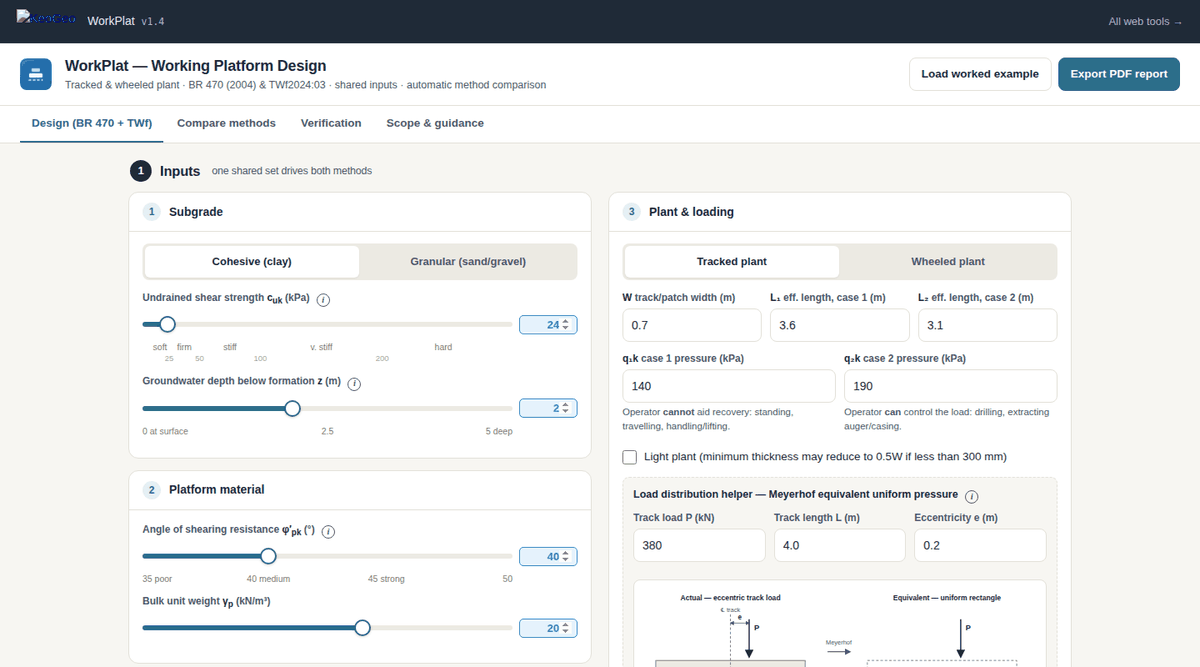
WorkPlat web app — Subgrade, platform material and plant loading with linked sliders; the cross-section, load-case demands and resistances, and the sensitivity and optioneering charts follow.

Subgrade, platform material and plant loading with linked sliders; the cross-section, load-case demands and resistances, and the sensitivity and optioneering charts follow.

What It Does

Both Platform Methods, One Set Of Inputs, No Mixing Of Load Factors.

Working platforms for piling rigs and cranes are designed to two guidance documents that answer the same question with different mechanics and safety formats. WorkPlat runs both correctly and completely from a shared input set:

  • BR 470 (2004) — the full Appendix A punching-shear flow: cohesive (cu) and granular (φ′) subgrades, Case 1 and Case 2 loadings and load factors, the geogrid option, the Meyerhof load-distribution helper and a wheeled-plant equivalent-patch mode.
  • TWf2024:03 §4.7 — Boussinesq load spread, digitised Figures 26–27 for δ/φ, BS 8004 bearing with groundwater factors, and the platform depth D iterated until VEd/VRd ≤ 1.00.
  • Inputs that guide you — sliders with linked numeric inputs, cu,k to 300 kPa with AS 1726 consistency terms (soft / firm / stiff / very stiff / hard), φ′s,k to 45°, and hover guidance on every field.
  • Load distribution mats — steel plates or timber bog mats with stiffness-limited spread (beam on elastic foundation, λ = (4EI/ks)0.25); both methods re-run and compare with and without the mat.
  • Load factors and safety formats — a card showing how each method reaches D, with live factored pressures.
  • Compare-methods tab — thickness versus subgrade strength sweeps (cu,k 20–80 kPa, φ′ 25–42°) with the current design point marked, plus a “why the methods differ” table.
  • Optioneering charts — required thickness versus applied pressure, one chart per method, both load cases swept independently, with auto-scaling axes.
  • Reference documents — links to the official BR 470 (BRE Bookshop) and TWf2024:03 (Temporary Works Forum) publications.

Need to run many cases? KeoGeo Pro adds a CSV batch processor to this tool — A$20/month, cancel any time.

Example Outputs

What You Get Out Of It.

Required Thickness Per Method

BR 470 and TWf2024:03 platform thickness for each load case, rounded per the guidance, with the governing case marked.

Load Cases — Demands And Resistances

Factored pressures, bearing resistances and utilisations for Case 1 and Case 2 (BR 470) and VEd/VRd (TWf).

Comparison And Sensitivity Charts

Thickness versus cu,k and φ′ for both methods, and thickness versus applied pressure for optioneering.

Calc Trail And PDF

Step-by-step calculations with substituted numbers and a print-ready PDF report.

Method & References

What The Numbers Are Based On.

Every calculation in WorkPlat is tied to a published source, and the in-app Sources & References section repeats this list next to the calculations themselves:

  • BRE (2004). BR 470 — Working platforms for tracked plant: good practice guide to the design, installation, maintenance and repair of ground-supported working platforms, including Appendix A worked examples.
  • Temporary Works Forum (2024). TWf2024:03 — Granular working platforms for construction plant, §4.7 design method and Appendix D1 worked example.
  • Meyerhof — load distribution through granular fill; Boussinesq — stress spread; BS 8004 — bearing resistance with groundwater factors.
  • Hetényi — beam on elastic foundation, used for the stiffness-limited spread of load-distribution mats.
  • AS 1726:2017 — consistency terms for cohesive soils.
Limitations

Where It Stops, And What You Still Have To Check.

  • Key limits of the routine BR 470 method are enforced and flagged: cohesive subgrades 20 kPa < cu < 80 kPa; free-draining granular platform fill with φ′ ≥ 35°; D/W ≤ 1.5 (otherwise punching shear is not the critical mechanism); minimum thickness 300 mm; ground slopes steeper than about 1:10 are outside scope.
  • Digitised charts (TWf Figs 26–27) introduce small interpolation error — noted on reports.
  • BR 470 worked-example agreement is within 1 %, looser than the 0.1 % achieved by the other KeoGeo tools.
  • Guidance documents evolve — pin the exact document revisions in the report header. Geogrid benefit is available in the BR 470 pathway only.

All KeoGeo tools are provided for preliminary assessment and educational purposes. Results must be verified by a suitably qualified engineer before use in design or construction; the full disclaimer is inside the app and in our terms.